
Frequently Asked Questions
Application Supporting Documents
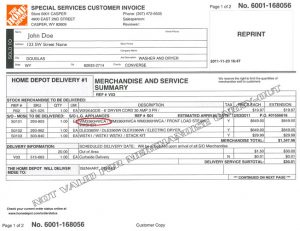
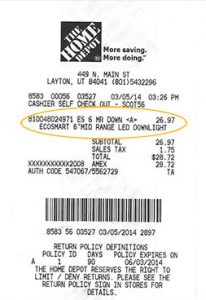
I bought my products at Home Depot and provided a receipt. Why would I need to provide a Home Depot Special Services Customer Invoice?
For certain products, such as clothes washers, Home Depot register receipts do not include model numbers. The Special Services Customer Invoice does, which allows us to process your application in a timely manner. If you have misplaced your customer invoice you can contact Home Depot with the customer agreement number from you register receipt and they will print a new one for you.
What documentation do I need to send in with my application?
All incentives require you to fill out the application completely and attach your itemized invoice and/or receipt. Each type of application has its own documentation requirements. Please review the instructions on the application to find the required documentation for your incentive.
Please keep proof of your application submission for your records. Proof of submission includes tracking information if you mail your application or a copy of the submission confirmation if you apply online. The program is not responsible for applications lost in the submittal process online or through the mail; however, we may be able to process an incentive request if you have proof of submission.
Didn’t find your answer? Please contact us.
Incentive Applications
Where do I find the model number for my appliance?
Model numbers can be found inside the door or on the back of the unit. However, model number locations can differ by manufacturer and appliance type. If you are not able to find the model number on your appliance, the model number can be found on your receipt. If your retail receipt does not have the model number, you may find it on the manual or on the manufacturer’s website.
Where can I find the serial number for my appliance?
Look inside the appliance door on the back of the unit and you should see the serial number on a sticker. Generally, the letters “SN” appears before the number.
On my Incentive Application, it mentions my home may be inspected. What does this mean?
Your home may be selected for a random inspection to verify the information on the application and ensure proper installation. Applications will not be processed until the inspection is complete.
If you are chosen for inspection, the inspector will call you to make an appointment. An inspection on average takes 20-30 minutes but can go longer if the work was not completed to program requirements. The inspector will contact the contractor if the work was not completed to program requirements.
How do I know if my product qualifies?
The easiest way to find out if your product qualifies is to look up the model number on our qualified list or review the product qualifications. You can find links to all of the information on our Qualified Products Pages:
I just bought a new home that came with qualified appliances. Can I apply for them?
If you can work with the builder to get itemized receipts for each appliance, and the completed application can be postmarked within 180 days of the original purchase, then yes. Receipts must list the model number of the appliance, the date purchased, the price paid, as well as the name and location of the retailer.
Is there a deadline for submitting my application?
Yes. The application must be postmarked within 180 days of item purchase and new appliance incentives, also 180 days of the work-completed date for HVAC incentives.
Why do you need my account number?
We use your account number to verify service address and the name on the account. Please note that we must write the check out to the account holder for the installation address. In order to qualify for incentives, the address where your item is installed must be served by Pacific Power or Rocky Mountain Power on a residential rate schedule.
California Qualified rate schedules are: D, DL-6, DS-8, DM-9 or NEM-35
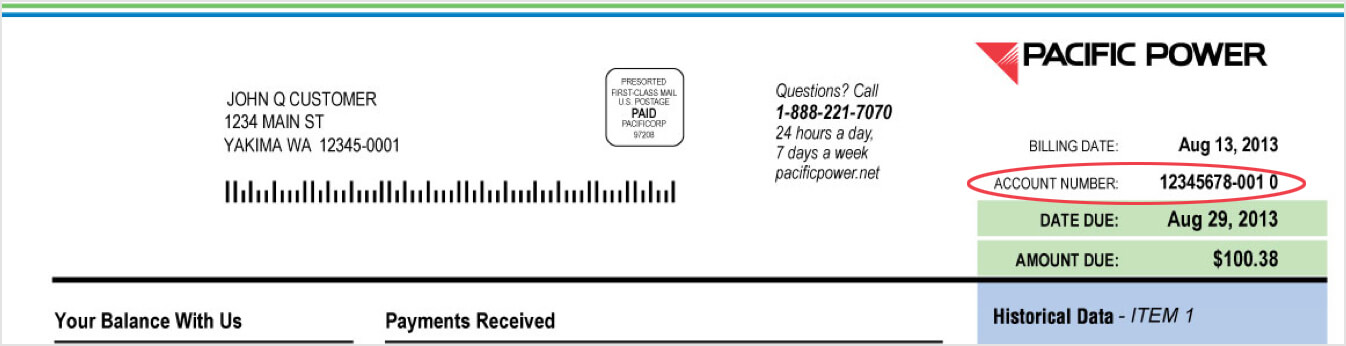
How do I find my account number?
Your account number can be found on your utility statement (example shown below). If you do not have your account number, you can call out billing department at 1-888-221-7070
Didn’t find your answer? Please contact us.
Heating and Cooling Equipment
Is a heat pump the same thing as a swamp cooler or evaporative cooler?
They are different. An electric air source heat pump (ASHP) transfers heat from the outside of a building to the inside, or vice versa. Swamp coolers and evaporative coolers cool the air by blowing it over water.
My furnace has a fan attached to it that blows air throughout my house. Is that a heat pump?
No. Air source heat pumps transfer heat from the outside of a building to the inside, or vice versa. This is different than how furnaces operate.
How do I determine my water heater fuel type?
Most household water heaters are either gas or electric. Look at the heater and see how many pipes go into the heater. If there are three one-inch diameter pipes and an electric plug, it is electric. You’ll also see a reset switch. If there are three one-inch diameter pipes on the top and one small one at the bottom with a valve to turn on/off, it is gas.
I have a gas furnace, but it uses electricity in order to run. Also, the fan system that blows warm air through my house is electric. Does this count as electric heat?
No. The fuel that created the heat must be electric in order to qualify as electric heat.
If I’m only installing insulation or windows, why do I have to answer questions about my heating source and my home’s cooling source?
The Wattsmart® Homes program uses this information to capture data about just how much electricity your home improvement project will save. These questions are required, so please fill them out. If you miss one, it could lead to a delay in processing your application.
My home is heated by gas, but for cooling I have a swamp cooler or window air conditioner. Do I qualify for windows and/or insulation?
Unfortunately, you do not qualify. The only qualified cooling systems are centrally ducted air conditioners and electric heat pumps.
I see that under qualifications, the application notes, “Home must have an electric heating system or electric cooling system serving at least 80% of the floor area.” What does this mean?
This means that the heating fuel source for at least 80% of your home must be electric (e.g. baseboard heaters or an electric furnace) or at least 80% of your home must be cooled by a centrally ducted cooling system (air conditioner or an electric heat pump).
Didn’t find your answer? Please contact us.
Incentive Checks
How do I get an incentive check if I’m a rental property owner or landlord?
Setting up a landlord account is an option. This is an account that exists in the background behind the tenant’s account. For more information on setting one up, contact us at 1-888-221-7070.
What is the status of my application, and when am I expect to receive my check?
If you applied online, you can check the status of your application. If you applied by mail, email us with your name and account number.
Checks are issued within six weeks upon receipt of a completed and approved incentive application. Allow additional time for mail service. We’ll contact you if we need more information to complete your application.
Who receives the incentive check?
Customer incentives are paid directly to the name on the utility account. Some products have both a customer and contractor incentive. Contractor incentives are paid to the contractor listed on the application and W-9.
Where does the funding for the incentives come from?
Funding for Wattsmart® programs comes from a small charge on customers’ bills. In the short term, these programs can help customers save on monthly utility bills and boost home performance. In long term, they work to keep everyone’s costs down and meet the region’s growing energy needs.
Didn’t find your answer? Please contact us.
Contractors
Does the trade ally (contractor) information box need to be completed?
Yes. Your contractor should provide this information unless the product was self-installed. If the product was self-installed, the box can be left empty.
How do I find a Qualified Contractor?
For a list of Qualified Contractors in your area, visit our Find a Vendor portal:
Find a California Qualified Contractor
Didn’t find your answer? Please contact us.
Abbreviations and Definitions
Energy Factor (EF)
Energy Factor, or EF, is the energy performance metric used for electric water heaters. The higher the EF, the more efficient the electric water heater. To look up your electric water heater’s EF, visit the ENERGY STAR® website.
Heat Pump (HP)
A device that uses a small amount of energy to heat your home. Unlike gas furnaces, they also have the ability to provide cooling when needed.
Heating Seasonal Performance Factor (HSPF)
Heating Seasonal Performance Factor is an equipment efficiency rating. HSPF is a measure of a heat pump’s energy efficiency over one heating season. It represents the total heating output of a heat pump (including supplementary back-up electric heat) during the normal heating season.
Modified Energy Factor (MEF)
Modified Energy Factor, or MEF, is a calculation used to compare the relative efficiency of different clothes washers. The higher the value, the more efficient the clothes washer. To find your clothes washer’s MEF, go to the ENERGY STAR® website.
National Fenestration Rating Council (NFRC)
The National Fenestration Rating Council (NFRC) is a 501(c)3, nonprofit organization that provides performance ratings on windows, doors and skylights. NFRC administers a certification and labeling program overseeing energy efficiency of windows, doors and skylights.
Heating Seasonal Performance Factor (HSPF)
Heating Seasonal Performance Factor is an equipment efficiency rating. HSPF is a measure of a heat pump’s energy efficiency over one heating season. It represents the total heating output of a heat pump (including supplementary back-up electric heat) during the normal heating season.
R-value
R-value of insulation is a measurement of the insulation’s ability to resist heat traveling through it. The higher the R-value, the more effective your insulation is at regulating the temperature inside your home.
Seasonal Energy Efficiency Ratio (SEER)
Seasonal Energy Efficiency Ratio, an equipment efficiency rating that measures how much energy it takes to cool the air. It measures how efficiently a cooling system will operate over an entire season. The higher the SEER, the more efficient the air conditioner.
Solar Heat Gain Coefficient (SHGC)
Solar Heat Gain Coefficient is the fraction of solar radiation admitted through a window. This tells you how well the product blocks heat caused from the sun. The lower the SHGC, the less solar heat it admits into your home.
U-factor
U-Factor measures the heat transfer through a window and lets you know how well the product insulates. The lower the U-Factor, the greater resistance to heat flow (in and out) and the better its insulation value.
Water Factor (WF)
Water Factor, or WF, is the water performance metric that allows the comparison of clothes washer water consumption independent of clothes washer capacity. The lower the value, the more water efficient the clothes washer is. To find your clothes washer’s WF, go to the ENERGY STAR® website.
Wattsmart® Homes (WSH)
Wattsmart® Homes is under Pacific Power’s Wattsmart® Homes program which offers incentives and services for residential energy efficiency projects.
Didn’t find your answer? Please contact us.